After Nearly Collapsing, Battery Startup Our Next Energy Heads to the Public Markets
Running a battery startup in the United States has long been brutally hard. Over the past two decades, far more battery companies have failed than succeeded, and shifting federal policy has forced several of them to close.
Our Next Energy (ONE) is one of the survivors. After a few near misses, the company has told TechCrunch that it will go public through a special purpose acquisition company (SPAC).
ONE is valued at $600 million before the deal. Its merger with Wen Acquisition Corp. is expected to bring in $400 million in gross proceeds, assuming no shareholders redeem their shares. The combined company will trade on Nasdaq under the ticker ONEE, with a pro forma equity value of $1 billion.
According to PitchBook, ONE has raised $483 million over its lifetime and was at one point valued at $1.3 billion. It has also received tens of millions of dollars in Michigan incentives tied to its investments and job creation there.
From electric cars to a new focus
ONE was founded by Mujeeb Ijaz, a former Ford and Apple engineer. His original concept was an electric vehicle that could draw power from two batteries with different chemistries. Each would play to its strengths: lithium iron phosphate (LFP) cells would handle everyday driving, while a more fragile but energy-dense manganese-rich pack would take over for occasional long trips. An early prototype covered more than 600 miles on a single charge.
The plan struggled as EV demand grew more slowly than expected and automakers pushed for cheaper batteries, often from China. Those pressures helped sink ONE's first attempt at a Series C round in late 2023. The company laid off a large share of its staff and gave up the lease on a planned $1.6 billion factory in Michigan.
Ijaz was ousted as CEO in December 2023, but he returned to the role in March 2025, after a new funding round closed. His brother's investment firm co-led that round.
Critics of ONE's early years said the company spent too much time building new products rather than focusing on one or two, as most startups do. When Ijaz came back, he said ONE would exit the automotive market and concentrate on grid-scale batteries.
ONE is far from alone in backing away from vehicle batteries. American automakers also bet heavily on battery plants and supply chains, expecting EV sales to surge as they had in China and Europe. When U.S. demand fell short, they needed other outlets for that capacity, and the power grid became an obvious target as it strained under the load from AI data centers. Both Ford and GM have announced their own energy storage products.
Many new grid batteries use LFP, which is safer and cheaper than the chemistries in most U.S. EVs, and Ijaz sees an opening there. He points out that the chemistry's roots in this country, and in some Chinese factories, trace back to the same origins. Just over a decade ago, he led the automotive division at A123 Systems, the company that first commercialized LFP.
Ijaz has also identified defense and locomotives as markets for ONE's batteries.
The defense pivot comes as no surprise. Nearly every battery company pitching investors today mentions defense, partly because Chinese firms are effectively shut out of that market. A domestic supply chain lets American companies charge a premium, shielded from Chinese competition. The margins are higher, though the market is much smaller than the EV sector.
Rail is less expected. Ijaz says ONE is gaining considerable traction with railroad companies. The company has built a hybrid locomotive with a 2.8 megawatt-hour battery, as well as a micro-hybrid design that uses a smaller battery to restart the diesel engine more quickly, much like a stop-start system in a car. Ijaz says customers are seeing a 50% improvement in diesel fuel consumption.
Three business lines and a Michigan plant
ONE now runs three business lines, which may be a sign of its old habits creeping back. Ijaz says the defense and rail lines were added for financial reasons. Grid customers, he explained, behave much like automotive buyers and will switch to Chinese suppliers if the price is low enough, with tariffs pushing them further in that direction. ONE therefore looked for customers that valued an American battery maker, and found them in defense and rail. He said he would have preferred to make grid storage the company's sole business.
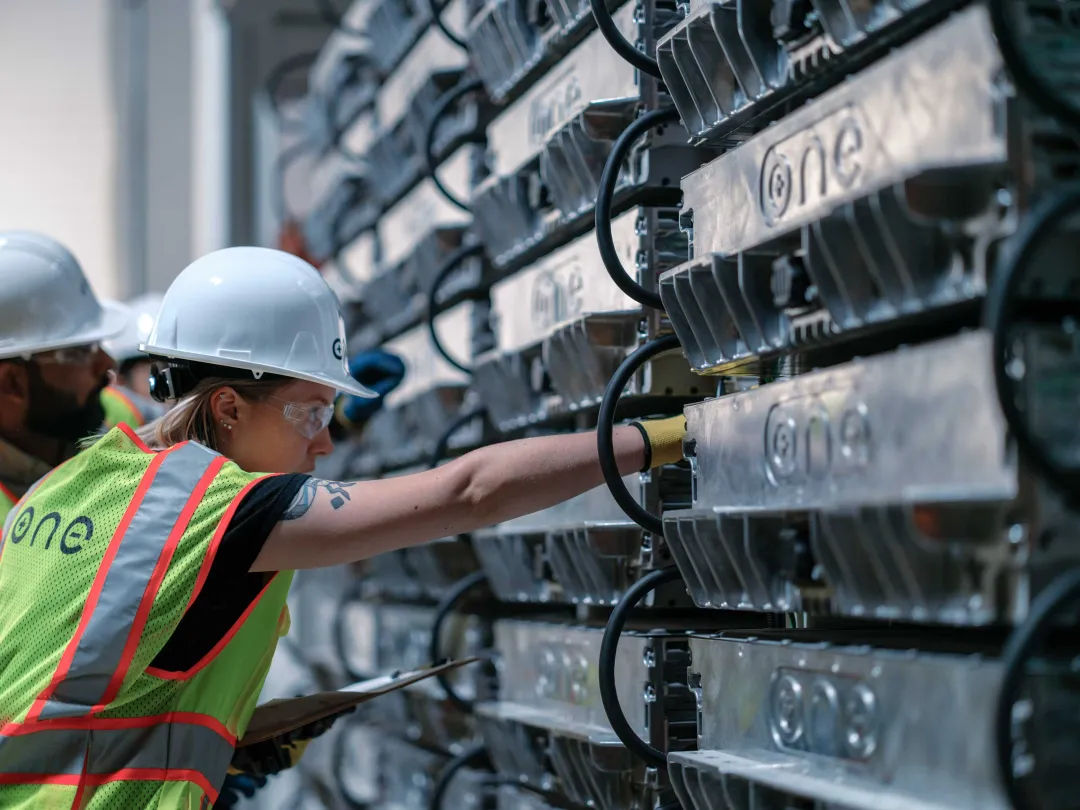
In Novi, Michigan, ONE operates a pack assembly plant that can build packs from cells at a rate of 3 gigawatt-hours per year. The plant uses cells from both Chinese and non-Chinese suppliers, as well as cells from ONE's own smaller factory nearby, which is being upgraded to produce 50 megawatt-hours per year.
Market outlook and finances
In the investor presentation TechCrunch reviewed, ONE groups its business into defense and rail. It estimates that drones and submarines make up most of a $16.2 billion defense market, and that defense-focused data centers add $4.1 billion. That data center segment appears to be the main outlet for grid-scale batteries. The rail market is projected to be worth $28.2 billion.
Both markets are sizable, but they are dwarfed by the EV sector, which is worth roughly $73 billion today and could reach $200 billion by the end of the decade, according to Grand View Research. ONE expects $30 million in revenue this year and hopes to double that next year. The company says it holds $200 million in binding, multi-year contracts with railroads and defense contractors.
Ijaz has not ruled out automotive work. He called the auto industry a race to the bottom on margins, but said ONE would consider an automotive contract if one came along, just not at any cost.
ONE's pitch centers on foreign entity of concern (FEOC) restrictions. The U.S. government cannot buy batteries made in China or those built with minerals from China-controlled supply chains, so ONE plans to target those buyers first. Plenty of battery companies are making the same argument today.
Ultimately, whether investors buy into ONE's vision will depend on whether the company has left its turbulent past behind and settled on a clear focus. It will need both to succeed in an increasingly cutthroat battery industry.