Lawmakers Push Back as Jensen Huang Returns to Nvidia
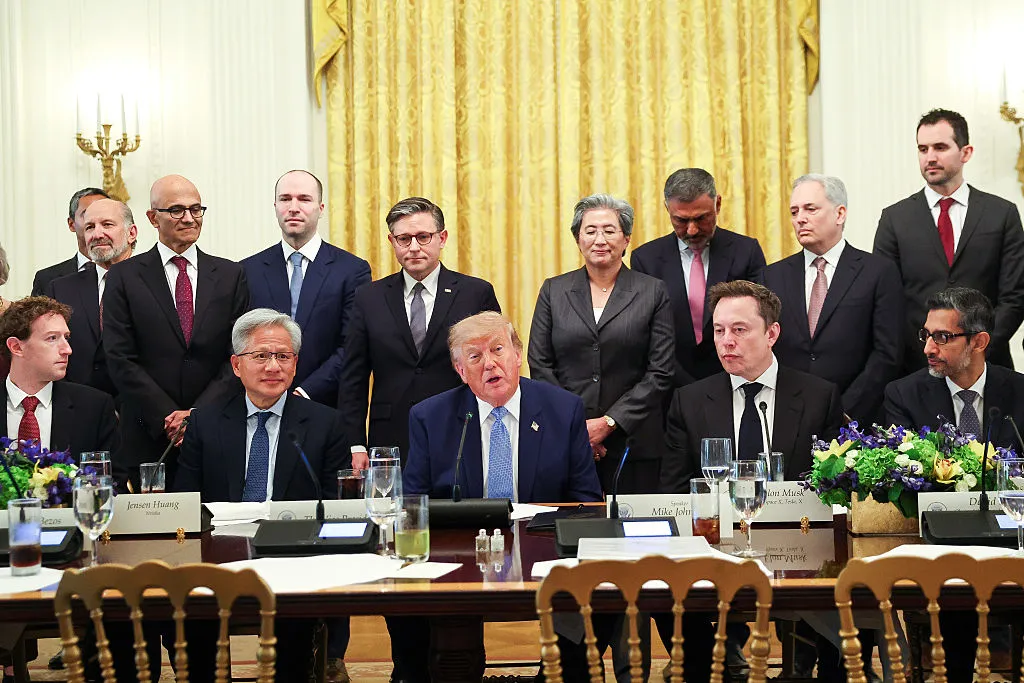
Jensen Huang is back at the helm of Nvidia. The chipmaker's board has reinstated its co-founder and CEO, who had been ousted roughly a week earlier after revelations about extramarital affairs, including one with a woman suspected of being a Chinese spy. Huang co-founded Nvidia in 1993 and helped turn it into one of the most powerful companies in the world, and his reinstatement suggests many see him as too big to fail.
The decision followed direct lobbying from President Donald Trump. On Monday, shortly after the news broke, Trump shared an AI-generated meme showing Huang holding a woman's bra, an image that echoed a famous photo from the president's own assassination attempt.
How and why the board made this call is still unclear. Nvidia matters economically, which makes it politically significant too. People disagree sharply about how essential Huang is to the company, and whether that value outweighs the security risks raised by his relationship with Alice Huang, which may have exposed Nvidia to Chinese espionage.
A tougher road ahead
Huang's return may not be smooth. Democrats made major gains in the midterm elections, and because Huang is now seen as aligned with Trump, he is expected to face closer scrutiny from congressional Democrats. He is scheduled to make a public appearance before the Senate next week and is expected to testify privately in December before several House committees, including the Intelligence, Foreign Affairs, and China Select committees.
Reactions from across the political spectrum
Lawmakers and public figures from both parties responded quickly on Monday, and most of the reaction was critical. Several Republicans were among the critics.
- Rep. Raja Krishnamoorthi called the reinstatement outrageous, noting that neither the government nor Nvidia's board has finished its investigation and that it is unknown what Chinese intelligence may have obtained.
- Sen. John Cornyn questioned the claim that Huang poses no national security risk and asked what that conclusion was based on.
- Sen. Chris Coons said the administration had sacrificed national security to give China access to advanced chips, calling the move reckless and urging Congress to act.
- Rep. Bill Huizenga described the woman involved as a spy and called for tougher action to stop China from taking American technology, including through chip sales.
- Sen. Ruben Gallego called for an investigation into stock trades made before the announcement, describing the White House as the most corrupt in history.
- Rep. Becca Balint accused Trump of dictating who a company should choose as its CEO and questioned whether he was hiding a major scandal.
- Andrew Yang said Nvidia needs Huang and Huang needs Nvidia, calling him the sheriff of the AI boom returning after a short break.
- Sen. Chuck Schumer said the rush to bring Huang back showed that Congress must act, accusing Trump of putting his financial interests and those of wealthy allies ahead of national security.
- Rep. Debbie Dingell said the board made an irresponsible choice before Congress had heard from Huang, and that it must explain why it moved forward without answers to serious security questions.
- Newt Gingrich said it was deeply troubling that Huang had a relationship with a Chinese Communist spy while helping China obtain large numbers of advanced chips, against US policy.
- Sen. Adam Schiff called for a thorough investigation of both Nvidia and the Trump administration over chip sales to China, noting that Trump had been warned more than a year earlier that China was targeting Nvidia.
- Sen. John Curtis asked which government officials had advised the board, what they said, and what basis the board used to conclude there was no national security risk.
- Sen. Chris Van Hollen linked the decision to Trump's stock trades in Nvidia and a $25 million donation to his ballroom, calling it a rigged system and urging stronger AI safeguards and export controls.
- Sen. Pete Ricketts said Huang's conduct, including affairs with subordinates and a suspected spy, did not support his return, and noted that the board itself had cited a lack of candor.
- Sen. Elissa Slotkin argued that Trump's pressure campaign showed that making money mattered more to him than national security or the rule of law.
- Rep. Don Bacon said Huang had been compromised by a Chinese spy, that Nvidia should have moved on without him, and that Congress needs to find out who approved high-end chip sales to China.
- Pennsylvania Governor Josh Shapiro called the decision another sign of a rigged system that protects those at the top and a White House that cannot be trusted.
- Rep. Yassamin Ansari said Huang and the entire Nvidia board should appear before Congress and the public immediately.
- Rep. Don Beyer accused Trump of putting private gain above the national interest by pressuring Nvidia's leadership, arguing that he was effectively trying to shield Huang from consequences.
These early responses suggest that Huang faces a difficult stretch ahead. Whether his return holds will depend on how the congressional hearings unfold and what answers the board and the administration can provide.